
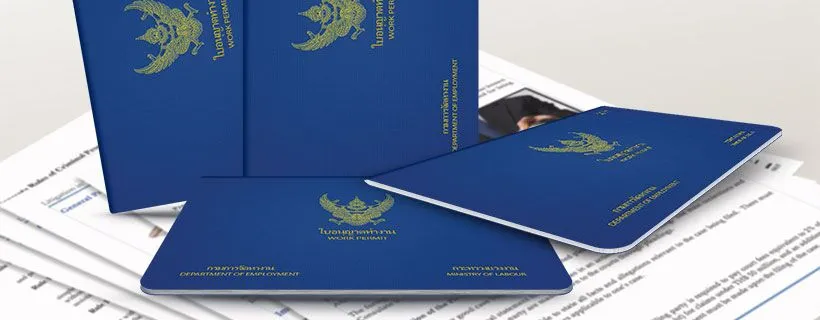
A Thai Work Permit is a legal authorization allowing a foreign national to perform work within the Kingdom of Thailand. Regardless of visa status, most foreigners engaging in employment or business operations must obtain a valid work permit before commencing work. The regulatory framework is designed to control foreign labor participation, protect domestic employment, and ensure proper tax and corporate compliance.
Although commonly associated with the Non-Immigrant “B” visa, a work permit is legally distinct from a visa. A visa allows entry and stay, while a work permit authorizes employment under specified conditions. Misunderstanding this distinction can result in serious legal consequences, including fines, deportation, and blacklisting.
This article provides a comprehensive examination of the Thai work permit system, including legal basis, eligibility requirements, employer obligations, application procedures, scope of permitted work, renewal rules, and compliance considerations.
Legal Framework
Work permits in Thailand are governed primarily by the Foreigners Working Management Emergency Decree B.E. 2560 (2017) and related ministerial regulations. The Ministry of Labour administers work permit issuance through the Department of Employment.
The law defines “work” broadly as any exertion of energy or use of knowledge for the purpose of earning wages or benefits, whether or not compensation is paid.
This broad definition means that even unpaid activities may require work authorization.
Relationship Between Visa and Work Permit
A foreign national must generally hold an appropriate non-immigrant visa before applying for a work permit.
The most common visa category associated with work permits is:
-
Non-Immigrant “B” (Business) Visa.
Other visa categories, such as Non-Immigrant “O” (family-based), may also support work permit applications in certain circumstances.
A work permit does not extend visa validity. Visa and work authorization must be maintained separately but concurrently.
Eligibility Requirements
Personal Qualifications
Applicants typically must:
-
Hold a valid non-immigrant visa,
-
Possess relevant educational qualifications,
-
Have appropriate work experience,
-
Not fall within prohibited occupations reserved for Thai nationals.
Thailand maintains a list of occupations reserved exclusively for Thai citizens.
Employer Qualifications
The sponsoring employer must:
-
Be legally registered in Thailand,
-
Meet minimum registered capital requirements,
-
Demonstrate active business operations,
-
Comply with tax and social security obligations,
-
Maintain a prescribed ratio of Thai to foreign employees.
Standard practice often requires:
-
A minimum level of paid-up capital per foreign employee,
-
A minimum number of Thai employees per foreign work permit holder.
Specific requirements may vary depending on business sector and company classification.
Required Documentation
Work permit applications generally require:
From the employee:
-
Passport and visa copies,
-
Educational certificates,
-
Resume and employment contract,
-
Medical certificate,
-
Passport photographs.
From the employer:
-
Company registration certificate,
-
Shareholder list,
-
VAT registration,
-
Corporate financial statements,
-
Office location map,
-
Evidence of tax payments,
-
Social security registration.
Incomplete documentation may delay or prevent approval.
Application Process
Step 1: Visa Preparation
The foreign national obtains the appropriate non-immigrant visa from a Thai embassy or consulate abroad.
Step 2: Work Permit Submission
After entry into Thailand, the employer submits the work permit application to the Department of Employment.
In some cases, certain pre-approval mechanisms allow application before entry.
Step 3: Issuance and Collection
Once approved, the applicant receives a work permit booklet (or digital authorization, depending on current administrative procedures).
Work may begin only after official issuance.
Scope and Limitations of Work Authorization
A Thai work permit specifies:
-
Employer name,
-
Job title,
-
Job description,
-
Work location.
The foreign employee may only perform the duties described in the permit and only for the designated employer.
Changes in employer, job description, or workplace location require formal amendment or reapplication.
Performing work outside the authorized scope constitutes a violation.
Validity and Renewal
Work permits are typically issued for up to one year, aligned with visa extension validity.
Renewal requires:
-
Ongoing employment verification,
-
Updated corporate documentation,
-
Proof of tax compliance,
-
Continued satisfaction of capital and staffing ratios.
Applications for renewal should be filed before expiration to avoid work interruption.
90-Day Reporting Requirement
Foreign nationals staying long-term in Thailand must report their residential address to Immigration every 90 days.
This reporting requirement is separate from work permit renewal.
Failure to report may result in fines.
Re-Entry Permit Considerations
If a foreign worker leaves Thailand while holding a visa extension linked to employment, a re-entry permit must be obtained before departure to preserve visa validity.
Leaving without a re-entry permit may cancel the extension, affecting work authorization continuity.
Employer Obligations
Employers must:
-
Ensure foreign employees hold valid work permits,
-
Maintain proper payroll documentation,
-
Register employees for social security,
-
Withhold and remit personal income tax,
-
Notify authorities upon termination of employment.
Failure to comply may result in corporate fines and reputational damage.
Termination of Employment
Upon termination:
-
The work permit must be returned or canceled,
-
The visa extension based on employment may become invalid,
-
The foreign national may need to depart Thailand or change visa status.
Prompt notification to authorities is required.
Penalties for Non-Compliance
Working without a valid work permit may result in:
-
Substantial fines,
-
Deportation,
-
Entry bans,
-
Criminal penalties in severe cases.
Employers hiring unauthorized foreign workers may also face fines and sanctions.
Enforcement efforts have increased in recent years.
Special Categories and BOI Promotion
Companies promoted by the Thailand Board of Investment (BOI) may receive:
-
Streamlined work permit processing,
-
Reduced documentary requirements,
-
Facilitated visa and work authorization services.
Certain specialized industries may also benefit from regulatory incentives.
Remote Work and Digital Activities
Thailand’s legal definition of work may encompass digital or remote activities conducted within the country, even if the employer is overseas.
Foreign nationals performing online services while physically present in Thailand should assess whether work authorization is required.
Ambiguity in digital work classification makes legal consultation advisable.
Strategic Considerations
Foreign professionals and employers should evaluate:
-
Proper corporate structure,
-
Capital adequacy,
-
Thai employee ratios,
-
Long-term visa planning,
-
Tax compliance alignment.
Early planning reduces risk of application rejection or enforcement action.
Conclusion
The Thai work permit system operates within a structured legal framework designed to regulate foreign labor participation while supporting economic development. Although the process is administratively detailed, compliance ensures lawful employment and reduces exposure to penalties.
Foreign nationals must maintain both valid visa status and work authorization, while employers must satisfy capital, staffing, and tax obligations. Careful coordination between immigration and labor compliance is essential for sustainable and uninterrupted employment in Thailand.
With proper preparation and adherence to regulatory requirements, foreign professionals can work legally and effectively within Thailand’s evolving economic environment.